
In today’s fast-paced business world, delivering a seamless customer experience is no longer optional—it’s essential. Companies are increasingly leveraging AI virtual agents to enhance interactions, reduce wait times, and improve efficiency. By integrating AI-driven customer experience solutions into contact centers, organizations can boost first call resolution (FCR) rates, minimize repeat inquiries, and ensure customers leave every interaction satisfied.
In this article, we’ll explore how AI virtual agents are transforming customer service, their impact on FCR, strategies for successful implementation, and how they ultimately enhance overall customer satisfaction.
Understanding First Call Resolution (FCR) and Its Importance
First Call Resolution refers to the ability of a contact center to resolve a customer’s issue during the initial interaction without requiring follow-ups. High FCR rates are a critical metric for evaluating operational efficiency and customer satisfaction. Customers who receive immediate resolutions are more likely to remain loyal, provide positive feedback, and recommend your brand.
However, achieving high FCR can be challenging. Common barriers include:
- Lack of accessible customer information
- Inefficient workflows
- High agent turnover or training gaps
- Complex issues requiring specialized knowledge
This is where AI virtual agents come in, offering real-time solutions and intelligent support that directly impacts FCR.
How AI Virtual Agents Enhance First Call Resolution
AI virtual agents, powered by machine learning and natural language processing, are revolutionizing how businesses interact with customers. Here’s how they specifically enhance FCR:
1. Instant Access to Customer Information
AI virtual agents integrate seamlessly with CRM systems and databases, giving agents immediate access to customer history, preferences, and previous interactions. This allows the virtual agent to provide accurate answers without delay, reducing the need for repeat calls.
2. Intelligent Routing and Escalation
Not every query can be resolved by AI alone. Virtual agents can intelligently route complex issues to human agents while providing context and suggested solutions. This reduces call transfers and ensures the customer’s issue is addressed promptly, boosting FCR.
3. 24/7 Availability
Unlike human agents, AI-driven virtual agents never sleep. Customers can get help anytime, increasing the likelihood of resolving issues on the first contact, especially outside business hours.
4. Consistent and Accurate Responses
AI virtual agents deliver consistent answers to frequently asked questions, reducing human error. Consistency builds trust with customers and ensures accurate resolutions from the first interaction.
The Link Between AI Virtual Agents and Customer Satisfaction
FCR is closely tied to customer satisfaction, but AI virtual agents enhance satisfaction in additional ways:
- Reduced Wait Times: Virtual agents handle multiple requests simultaneously, cutting down queues and providing faster responses.
- Personalized Experiences: By analyzing customer data, AI virtual agents offer tailored solutions and product recommendations.
- Multichannel Support: Customers can interact via chat, email, SMS, or social media, making service more convenient.
When customers experience efficiency, personalization, and ease of use, satisfaction naturally improves.
Top 5 Virtual Agent Providers Transforming AI-Driven Customer Experience
Businesses are turning to AI virtual agents to deliver seamless, efficient, and personalized customer support. AI-driven customer experience is no longer a luxury—it’s a necessity. Virtual agents help organizations improve first call resolution, reduce wait times, and boost customer satisfaction by providing instant, intelligent assistance across multiple channels. Here’s a list of the top 5 virtual agent providers leading the market in innovation and performance.
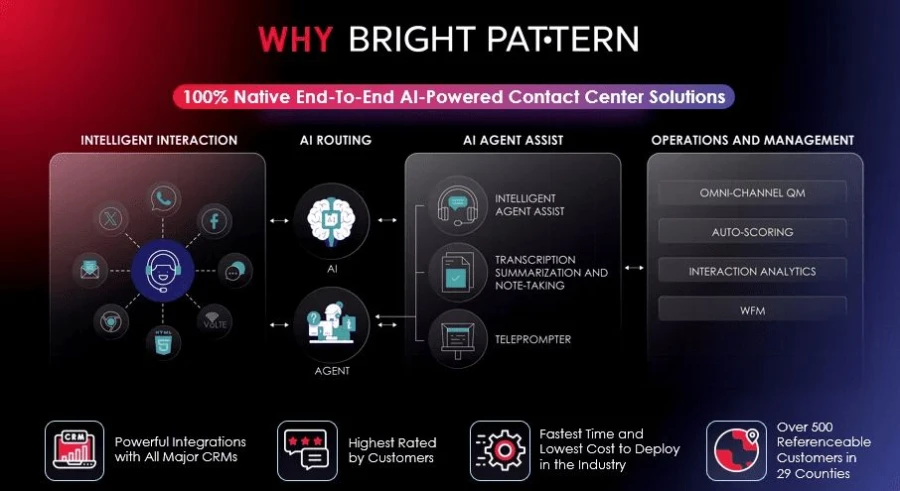
1. Bright Pattern – Smarter Omnichannel Virtual Agents
Bright Pattern stands out for its AI-powered virtual agents that seamlessly integrate across voice, chat, email, SMS, and social messaging channels. Its platform enables highly personalized interactions, real-time analytics, and smart routing, helping businesses resolve customer issues faster and more efficiently. With Bright Pattern, companies can deliver a unified, AI-driven customer experience that consistently improves first call resolution rates.
2. Genesys – Advanced AI Virtual Agents
Genesys offers AI virtual agents that combine natural language understanding with predictive routing. Their AI-driven solutions allow businesses to automate routine inquiries and support complex customer journeys while maintaining a human-like interaction experience.
3. Nuance – Conversational AI Leaders
Nuance specializes in conversational AI and virtual assistants for enterprises. Their virtual agents excel in understanding complex speech patterns and providing context-aware responses, making them a top choice for healthcare, finance, and large-scale service industries.
4. IBM Watson Assistant – Scalable AI-Powered Assistance
IBM Watson Assistant delivers virtual agents that can be deployed across web, mobile, and messaging platforms. Its AI-driven capabilities include intent recognition, dialogue management, and integration with enterprise systems for smarter customer interactions.
5. LivePerson – AI Messaging Solutions
LivePerson offers AI virtual agents with strong focus on messaging channels, enabling real-time, personalized conversations at scale. Their platform leverages machine learning to continuously improve interactions and drive higher customer satisfaction.
Implementing AI-Driven Customer Experience Successfully
To maximize the benefits of AI virtual agents, organizations should follow best practices for implementation:
1. Identify Key Use Cases
Determine where AI virtual agents will have the most impact. Common areas include:
- Billing inquiries
- Password resets
- Order tracking
- Troubleshooting basic technical issues
Prioritizing high-volume, repetitive tasks allows human agents to focus on complex interactions.
2. Integrate with Existing Systems
Seamless integration with CRM, ERP, and knowledge management systems ensures that virtual agents have all the information they need to provide accurate solutions.
3. Train AI With Quality Data
The effectiveness of AI virtual agents depends on the quality of their training data. Ensure historical customer interactions are analyzed to teach the AI how to respond intelligently.
4. Monitor Performance and Optimize
Continuous monitoring of FCR rates, customer satisfaction scores, and interaction quality helps refine AI performance. Feedback loops allow AI virtual agents to learn and improve over time.
Case Studies: Success Stories of AI Virtual Agents
Several leading companies across various industries have seen measurable improvements in first call resolution (FCR) and overall customer satisfaction after implementing AI-driven virtual agents. These examples demonstrate the real-world value of AI in enhancing customer experiences.
Telecommunications Industry
A major telecom provider faced challenges with high call volumes, especially for billing and service inquiries. Customers often had to make multiple calls before getting their issues resolved, leading to frustration and lower satisfaction scores. By deploying AI virtual agents, the company was able to automate routine inquiries and provide instant, accurate answers. As a result, repeat calls were reduced by 35%, freeing human agents to focus on more complex issues and significantly improving the overall customer experience.
E-commerce
An online retailer struggling with order tracking delays implemented AI virtual agents to provide real-time updates to customers. The virtual agents handled queries 24/7, including nights and weekends, ensuring that customers received immediate responses regardless of the time. This implementation led to a 40% improvement in first contact resolution, as many customers no longer needed to follow up with additional inquiries. The AI agents not only enhanced efficiency but also increased customer trust and loyalty by consistently delivering timely updates.
Healthcare
A healthcare provider aimed to streamline appointment scheduling and insurance queries, which were frequently creating bottlenecks in patient service. By integrating AI-driven customer experience tools, the provider allowed patients to schedule appointments, confirm insurance details, and get answers to common questions without waiting for human assistance. This reduced administrative delays and led to a significant increase in patient satisfaction scores. Patients reported faster service and fewer errors, highlighting how AI virtual agents can improve both operational efficiency and the quality of care.
These case studies illustrate the tangible impact AI virtual agents can have across industries. By automating routine tasks, providing instant support, and freeing human agents for more complex interactions, businesses can achieve higher FCR rates and enhance customer satisfaction in meaningful ways.
Challenges and Considerations
While AI virtual agents offer significant benefits, companies should be aware of potential challenges:
- Complex Issues: AI may not resolve highly specialized or nuanced problems.
- Customer Acceptance: Some customers prefer human interaction, so offering seamless escalation options is crucial.
- Data Privacy: Ensuring compliance with data protection regulations is mandatory when AI accesses personal customer information.
Overcoming these challenges requires a balanced approach that combines human expertise with AI efficiency.
Future Trends in AI-Driven Customer Experience
The landscape of AI virtual agents is rapidly evolving. Key trends include:
- Voice AI Integration: AI agents capable of understanding and responding to natural speech, enhancing phone support.
- Predictive Assistance: AI predicting customer needs based on past behavior to proactively offer solutions.
- Emotional AI: Detecting customer sentiment and adjusting responses to improve satisfaction.
- Hyper-Personalization: AI delivering highly tailored interactions that increase engagement and loyalty.
Organizations embracing these innovations will continue to see improved FCR and higher customer satisfaction rates.
Conclusion
AI virtual agents are transforming customer service by significantly enhancing first call resolution and boosting overall customer satisfaction. By providing instant, accurate, and personalized support, these AI-driven solutions reduce repeat inquiries, shorten response times, and ensure customers get the help they need on the first interaction. This seamless integration of AI into customer service allows companies to deliver a consistent, high-quality experience across all channels.
Moreover, AI virtual agents help optimize agent workloads by handling routine and repetitive tasks, allowing human agents to focus on complex or sensitive issues. This not only improves operational efficiency but also ensures that customers receive expert attention when necessary, further strengthening trust and satisfaction. Companies leveraging AI-driven customer experience solutions gain a competitive edge by combining speed, accuracy, and personalization in every interaction.
Finally, businesses that strategically implement AI virtual agents position themselves for long-term success. Investing in these technologies today ensures a more responsive, adaptable, and customer-centric future. By embracing AI, organizations can cultivate stronger, lasting relationships with their customers, improve key performance metrics like first call resolution, and ultimately drive loyalty and growth.